library(tidyverse)
library(tidymodels)27 Threshold selection for classification models
In this example, we will
- load and preprocess data
- define a workflow
- use cross-validation to determine a threshold using the F-measure
- train the final model
- evaluate the model using cross-validation and holdout data
- predict
using the Loan prediction dataset to illustrate the whole process.
Load the required packages:
Load and preprocess the data:
filename <- paste0(
  "https://gedeck.github.io/machine-learning-with-tidymodels/",
  "datasets/loan_prediction.csv"
)
data <- read_csv(filename, show_col_types = FALSE) |>
  drop_na() |>
  mutate(
    Gender = as.factor(Gender),
    Married = as.factor(Married),
    Dependents = gsub("\\+", "", Dependents) |> as.numeric(),
    Education = as.factor(Education),
    Self_Employed = as.factor(Self_Employed),
    Credit_History = as.factor(Credit_History),
    Property_Area = as.factor(Property_Area),
    Loan_Status = factor(Loan_Status, levels = c("N", "Y"),
      labels = c("No", "Yes"))
  ) |>
  select(-Loan_ID)
Split dataset into training and holdout data, prepare for cross-validation:
set.seed(123)
data_split <- initial_split(data, prop = 0.8, strata = Loan_Status)
train_data <- training(data_split)
holdout_data <- testing(data_split)

resamples <- vfold_cv(train_data, v = 10, strata = Loan_Status)
cv_metrics <- metric_set(roc_auc, accuracy)
cv_control <- control_resamples(save_pred = TRUE)
Define the recipe, the model specification (elasticnet logistic regression), and combine them into a workflow:
formula <- Loan_Status ~ Gender + Married + Dependents + Education +
  Self_Employed + ApplicantIncome + CoapplicantIncome + LoanAmount +
  Loan_Amount_Term + Credit_History + Property_Area
recipe_spec <- recipe(formula, data = train_data) |>
  step_dummy(all_nominal(), -all_outcomes())

model_spec <- logistic_reg(engine = "glm", mode = "classification")

wf <- workflow() |>
  add_model(model_spec) |>
  add_recipe(recipe_spec)
Use the workflow for cross-validation and training the final model using the full dataset:
result_cv <-  fit_resamples(wf, resamples, metrics = cv_metrics,
  control = cv_control)
fitted_model <- wf |> fit(train_data)
Estimate model performance using the cross-validation results and the holdout data:
cv_results <- collect_metrics(result_cv) |>
  select(.metric, mean) |>
  rename(.estimate = mean) |>
  mutate(result = "Cross-validation", threshold = 0.5)
holdout_predictions <- augment(fitted_model, new_data = holdout_data)
holdout_results <-  bind_rows(
  c(roc_auc(holdout_predictions, Loan_Status, .pred_Yes,
      event_level = "second")),
  c(accuracy(holdout_predictions, Loan_Status, .pred_class))) |>
  select(-.estimator) |>
  mutate(result = "Holdout", threshold = 0.5)
performance <- probably::threshold_perf(
result_cv |> collect_predictions(),
Loan_Status, .pred_Yes, seq(0.1, 0.9, 0.01), event_level = "second",
metrics = metric_set(j_index, f_meas, kap))max_values <- performance |>
arrange(desc(.threshold)) |>
group_by(.metric) |>
filter(.estimate == max(.estimate)) |>
filter(row_number() == 1)
ggplot(performance, aes(x = .threshold, y = .estimate, color = .metric)) +
geom_line() +
geom_vline(data = max_values, aes(xintercept = .threshold, color = .metric))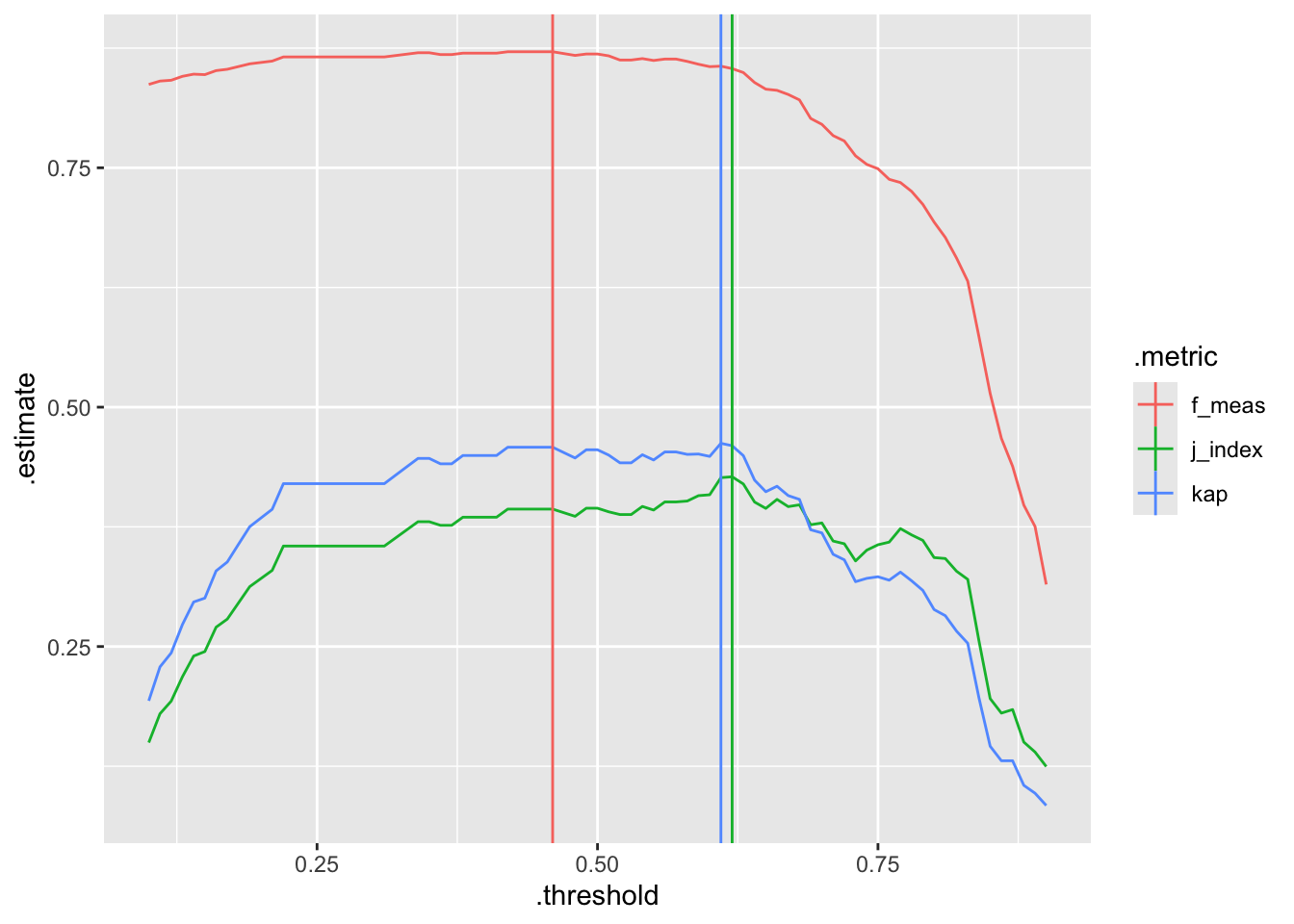
We decide to select the threshold that maximizes the F-measure:
threshold <- max_values |>
filter(.metric == "f_meas") |>
pull(.threshold)We can now calculate the performance metrics using predictions at the selected threshold.
cv_predictions <- collect_predictions(result_cv) |>
mutate(
.pred_class = factor(ifelse(.pred_Yes >= threshold, "Yes", "No"))
)
cv_threshold_results <- bind_rows(
c(accuracy(cv_predictions, Loan_Status, .pred_class))
) |>
select(-.estimator) |>
mutate(result = "Cross-validation", threshold = threshold)
holdout_predictions <- augment(fitted_model, new_data = holdout_data) |>
mutate(
.pred_class = factor(ifelse(.pred_Yes >= threshold, "Yes", "No"))
)
holdout_threshold_results <- bind_rows(
c(accuracy(holdout_predictions, Loan_Status, .pred_class))
) |>
select(-.estimator) |>
mutate(result = "Holdout", threshold = threshold)The performance metrics are summarized in the following table.
bind_rows(
cv_results,
holdout_results,
cv_threshold_results,
holdout_threshold_results,
) |>
pivot_wider(names_from = .metric, values_from = .estimate) |>
kableExtra::kbl(digits = 3) |>
kableExtra::kable_styling(full_width = FALSE)| result | threshold | accuracy | roc_auc |
|---|---|---|---|
| Cross-validation | 0.50 | 0.799 | 0.752 |
| Holdout | 0.50 | 0.825 | 0.733 |
| Cross-validation | 0.46 | 0.802 | NA |
| Holdout | 0.46 | 0.835 | NA |
We can see that the reduced threshold leads to a higher accuracy.
Code
The code of this chapter is summarized here.
Show the code
knitr::opts_chunk$set(echo = TRUE, cache = TRUE, autodep = TRUE,
fig.align = "center")
library(tidyverse)
library(tidymodels)
filename <- paste0(
"https://gedeck.github.io/machine-learning-with-tidymodels/",
"datasets/loan_prediction.csv"
)
data <- read_csv(filename, show_col_types = FALSE) |>
drop_na() |>
mutate(
Gender = as.factor(Gender),
Married = as.factor(Married),
Dependents = gsub("\\+", "", Dependents) |> as.numeric(),
Education = as.factor(Education),
Self_Employed = as.factor(Self_Employed),
Credit_History = as.factor(Credit_History),
Property_Area = as.factor(Property_Area),
Loan_Status = factor(Loan_Status, levels = c("N", "Y"),
labels = c("No", "Yes"))
) |>
select(-Loan_ID)
set.seed(123)
data_split <- initial_split(data, prop = 0.8, strata = Loan_Status)
train_data <- training(data_split)
holdout_data <- testing(data_split)
resamples <- vfold_cv(train_data, v = 10, strata = Loan_Status)
cv_metrics <- metric_set(roc_auc, accuracy)
cv_control <- control_resamples(save_pred = TRUE)
formula <- Loan_Status ~ Gender + Married + Dependents + Education +
Self_Employed + ApplicantIncome + CoapplicantIncome + LoanAmount +
Loan_Amount_Term + Credit_History + Property_Area
recipe_spec <- recipe(formula, data = train_data) |>
step_dummy(all_nominal(), -all_outcomes())
model_spec <- logistic_reg(engine = "glm", mode = "classification")
wf <- workflow() |>
add_model(model_spec) |>
add_recipe(recipe_spec)
result_cv <- fit_resamples(wf, resamples, metrics = cv_metrics,
control = cv_control)
fitted_model <- wf |> fit(train_data)
cv_results <- collect_metrics(result_cv) |>
select(.metric, mean) |>
rename(.estimate = mean) |>
mutate(result = "Cross-validation", threshold = 0.5)
holdout_predictions <- augment(fitted_model, new_data = holdout_data)
holdout_results <- bind_rows(
c(roc_auc(holdout_predictions, Loan_Status, .pred_Yes,
event_level = "second")),
c(accuracy(holdout_predictions, Loan_Status, .pred_class))) |>
select(-.estimator) |>
mutate(result = "Holdout", threshold = 0.5)
performance <- probably::threshold_perf(
  result_cv |> collect_predictions(),
  Loan_Status, .pred_Yes, seq(0.1, 0.9, 0.01), event_level = "second",
  metrics = metric_set(j_index, f_meas, kap))
max_values <- performance |>
  arrange(desc(.threshold)) |>
  group_by(.metric) |>
  filter(.estimate == max(.estimate)) |>
  filter(row_number() == 1)
ggplot(performance, aes(x = .threshold, y = .estimate, color = .metric)) +
  geom_line() +
  geom_vline(data = max_values, aes(xintercept = .threshold, color = .metric))
threshold <- max_values |>
  filter(.metric == "f_meas") |>
  pull(.threshold)
cv_predictions <- collect_predictions(result_cv) |>
  mutate(
    .pred_class = factor(ifelse(.pred_Yes >= threshold, "Yes", "No"))
  )
cv_threshold_results <-  bind_rows(
  c(accuracy(cv_predictions, Loan_Status, .pred_class))
) |>
  select(-.estimator) |>
  mutate(result = "Cross-validation", threshold = threshold)
holdout_predictions <- augment(fitted_model, new_data = holdout_data) |>
  mutate(
    .pred_class = factor(ifelse(.pred_Yes >= threshold, "Yes", "No"))
  )
holdout_threshold_results <-  bind_rows(
  c(accuracy(holdout_predictions, Loan_Status, .pred_class))
) |>
  select(-.estimator) |>
  mutate(result = "Holdout", threshold = threshold)
bind_rows(
  cv_results,
  holdout_results,
  cv_threshold_results,
  holdout_threshold_results,
) |>
  pivot_wider(names_from = .metric, values_from = .estimate) |>
  kableExtra::kbl(digits = 3) |>
  kableExtra::kable_styling(full_width = FALSE)